Free limits
Is Google AI Studio text to speech free?
Yes for drafting, auditioning and short production work with a Google account — and no at scale, because hosted audio costs compute. Here is what that boundary actually looks like in practice.
What "free" covers, and what it does not
Two different things get called free in this space, and confusing them is why people are disappointed. Free as in no payment method attached: you can open the playground with a Google account, generate speech and download the file. Free as in no cost at scale: that does not exist for any hosted model, because generating audio costs compute.
The practical consequence is simple. Draft, audition and short production work fit comfortably in the playground. Batch jobs — a hundred product clips, a whole course library — belong on a surface where you can see the quota before you start rather than discovering it halfway through.
Where the caps actually land
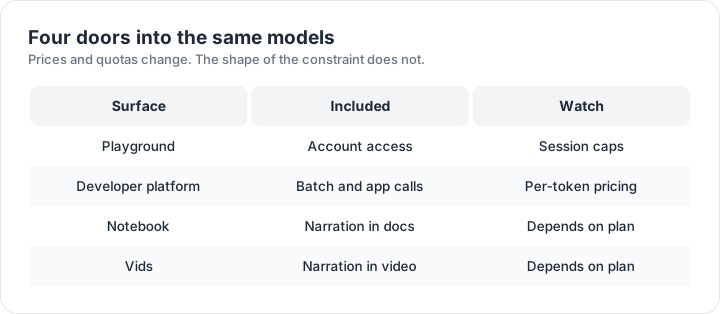
| Surface | What you get | What to watch |
|---|---|---|
| Browser playground | Model access with a Google account | Session and daily caps |
| Developer platform | Programmatic calls, batching and app features | Per-token pricing and free-tier caps |
| Gemini Notebook | Narration inside a document workspace | Depends on your plan |
| Google Vids | Narration inside a video project | Depends on your plan |
Quotas and prices change often enough that any number written here would be wrong within a quarter. What does not change is the shape of the constraint: interactive use is cheap, batch use is metered, and long audio costs more tokens than short audio. If you need a number to plan with, take it from the current platform pricing page on the day you plan.
Working inside the caps without wasting them
- Freeze the script before you generate. Every rewrite is a paid-for render, whether the currency is tokens or patience.
- Audition on the same eight-second test line across three voices rather than generating three full scripts.
- Chunk long work and log which chunks succeeded, so a failure costs one chunk rather than the whole project.
- Do style iteration at low length: the brief is settled in a sentence, not in a chapter.
- Keep the downloaded WAV. Re-downloading is not a thing, and a lost render is a full repeat.
When the free lane stops being enough
The signal is not a single failed request; it is a pattern. You are regenerating because you cannot audition properly, you are queuing work behind rate limits, or you are avoiding a job because you know it will not fit. At that point the honest move is to attach a billing surface and treat the audio budget as a production cost, the same way you would treat stock music or a voice actor.
Until then, most creators do not need more quota. They need a settled script and one auditioned voice, which are free.
Free does not mean without terms
A free lane is still governed by terms: what you may do with generated audio, whether it can be used in ads, how attribution works. Read the terms attached to the model you are using before you ship audio in something paid. That is not a formality — it is the part that determines whether the free clip is actually usable.
Frequently asked questions
Can I use text to speech in AI Studio without paying?
The browser playground is usable with a Google account, which is how most people should start. Beyond that, quotas depend on the platform surface and on your account, and they change: Google publishes the current numbers, and this page deliberately does not restate them because a stale figure is worse than no figure.
What happens when I hit a limit?
Requests start failing rather than silently degrading, usually with a rate or quota error. The practical response is to batch work, keep a log of what succeeded, and re-run only the failed items instead of regenerating everything.
Is the free output lower quality than the paid output?
No. The model returns the same audio either way; the limits are about volume and rate, not fidelity. A clip generated inside the free lane is the same WAV you would get with a billing account attached.
Do failed requests use up my quota?
Usually not, but do not design around that. Build the habit of validating the script before a long run — a chunk that fails for a correctable reason costs you time even when it does not cost you quota.
Can I use the free lane for client work?
Technically the tool does not care, but commercially you should not build a delivery promise on a quota you do not control. If a client project depends on speech generation, price in a paid surface or an explicit buffer.
Is there a free alternative to Gemini TTS?
There are browser-based speech tools that run entirely on your machine, and they are a good fit for short, offline, unlimited drafting. They generally lose on acting, breath and multi-speaker work, which is exactly what the Gemini generation is good at.