Prompts
Gemini TTS prompts that actually change the read
The transcript is a verbatim script. Acting notes belong in the style field, not in the text — and once you separate the two, one script can sound like a calm narrator or an excited host without a rewrite.

Style lives outside the transcript
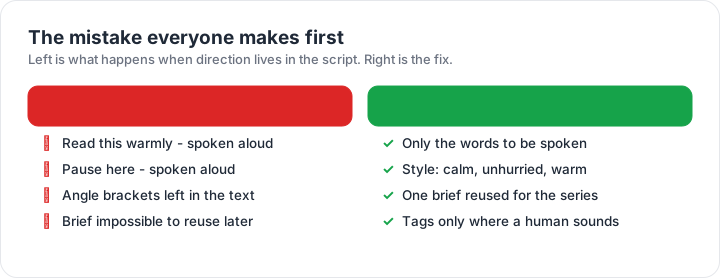
This is the single change that separates a good first attempt from a wasted afternoon. In the current generation the transcript is a verbatim script: the model says what is written. Acting notes therefore belong in the style field that travels with the request, and the transcript stays clean. The same script plus two different briefs gives you a calm narrator and an excited host without editing a word.
The four levers in a usable brief
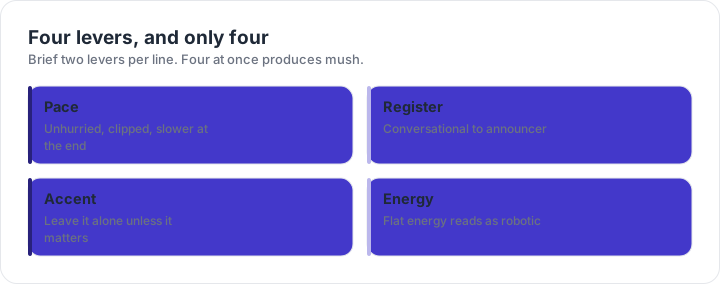
Pace is the lever people forget. Most flat reads are not emotionally wrong, they are rhythmically uniform: every sentence the same length, every comma the same pause. Naming pace explicitly — "unhurried", "clipped", "slower through the second half" — fixes more renders than any adjective about mood.
Register is the second lever: how formal the voice sits, from conversational to announcer. Accent is the third, and it is the one to leave alone unless you have a reason, because a small accent instruction produces a bigger change than you expect. Energy is the fourth, and it is usually the one doing the work when someone says a read sounds "robotic" — flat energy, not flat pitch.
Three briefs you can copy
Each of these is a complete style brief for a different job. Paste one into the style field, keep the transcript clean, and adjust one lever at a time rather than rewriting the whole brief.
Calm, unhurried delivery. Neutral North American accent. Slight warmth in the voice, no upward inflection at sentence ends. Pause briefly at each comma.
Bright and quick without shouting. Clipped consonants, rising energy through the second half of each sentence, confident close on the last word.
Speaker 1: warm, conversational, medium pace, small laugh in the voice. Speaker 2: dry and deadpan, slightly slower, flat affect. Leave a short beat between speaker turns.
Vocal tags and where they belong
Tags are small vocal events written inline, inside the transcript, exactly where a human would make that sound. They are punctuation for the body: a pause, a breath, a laugh. Used sparingly they rescue a line that would otherwise be perfectly flat. Used as decoration they turn a read into a sound-effects track.
| Tag | What it does | Where it works |
|---|---|---|
| <short pause> | A beat between phrases | Between clauses that need air |
| <laugh> | A short laugh inside the line | Sponsor reads, casual hosts |
| <sigh> | Audible exhale | Resignation, relief, fatigue |
| <cough> | A cough mid-sentence | Character work only |
| <breath> | An audible inhale | Whispered or intimate reads |
| <gasp> | Sharp intake of breath | Surprise beats, drama |
Placement rules are simple and worth following literally. One tag per sentence. The tag goes immediately before the word where the sound should land, not at the end of the line. And never stack two tags together — the model tends to produce one audible event and then a pause where the second tag was.
Tags that backfire
- A laugh tag in a sentence with no joke in it. The model will laugh; the audience will not.
- A breath tag in every sentence. Natural speech has air, but not at a metronome.
- Angle brackets left in the script from a template. The model reads them as text.
- A pause tag used to fix a pacing problem that the style brief should have solved.
- Tags in a two-speaker scene without labelling which speaker owns the line.
A two-speaker prompt that survives editing
Write the transcript as labelled lines, then put both deliveries into one brief with explicit contrast. Label speakers consistently, keep the scene under a few minutes, and regenerate the whole scene rather than patching a single line: a patched line rarely matches the room tone of the take around it.
Host: So the first thing people get wrong is the script itself.
Guest: <short pause> They write it for the page.
Host: Exactly. It reads fine, and then you hear it and something is off.
Guest: It is the rhythm. Every sentence is the same length.
If the second voice keeps drifting into the first, the fix is contrast in the brief, not more tags in the script. Give one speaker a faster pace and a brighter register, and the separation usually holds for the length of a short scene.
Frequently asked questions
Where do style instructions go?
In the style field of the speech metadata that travels with the request, not in the transcript. The 3.8 generation treats the text as a verbatim script, so a line like "read this warmly" will be read out loud as words rather than obeyed as an instruction.
How long should a style brief be?
Twelve to twenty-five words. A brief that lists five attributes with no priority produces a compromise; a brief that names two and lets the voice do the rest produces a performance. Write it as a direction to an actor, not as a specification for a machine.
Do vocal tags work in every model?
Tags such as a short pause, a laugh, a sigh, a cough, a breath or a gasp are recognised by the current generation, with more reliable handling on the fidelity model. Older previews may read the tag as text, which is exactly the failure people notice first.
Can I use the same brief for every voice?
For a series, yes — reusing one brief with one voice is how you get consistency. Across different voices, no: a brief tuned for an Excitable voice will overact a Smooth one. Re-tune the brief when you change the cast.
How do I get a laugh in the right place?
Put the tag immediately before the word where the laugh should land, on its own inside the line, and keep one tag per sentence. Two tags in a sentence usually produces one audible event and one awkward pause.
Why does my two-speaker prompt sound like one person arguing with themselves?
Because the two briefs describe the same delivery. Contrast the pace as well as the tone: one speaker faster and brighter, one slower and drier. If both briefs say "warm and friendly", the model has nothing to separate.