Voices
The 30 Gemini TTS voices, and how to cast them
Thirty presets, one casting decision each. The tone label is the shortest honest description you will get — read it as default energy, then use the style brief to set pace, mood and accent.

Thirty voices, organised by what they are built for
Every preset is a casting decision, and the tone label is the shortest honest description of it you will get. Read the label as a hint about default energy, not as a hard limit: the style brief can push a Bright voice into something restrained, and it can flatten an Excitable one into a news read. What the brief cannot change is timbre, age impression and the shape of the consonants — those belong to the voice.
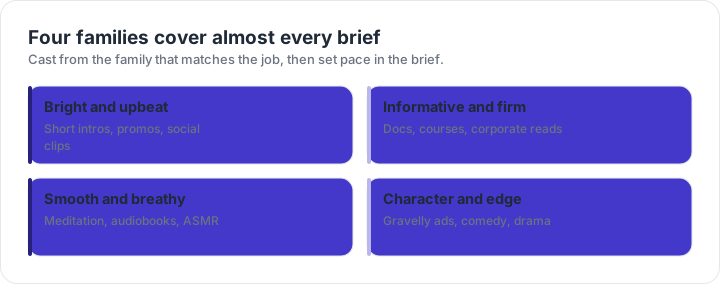
Every preset voice in the current generation
| Voice | Tone | Where it earns its place |
|---|---|---|
| Zephyr | Bright | Short intros, promo stings |
| Puck | Upbeat | Friendly explainers and tutorials |
| Charon | Informative | Documentary narration |
| Kore | Firm | Corporate narration, audiobooks |
| Fenrir | Excitable | Sports reads, hype trailers |
| Leda | Youthful | Teen-facing social content |
| Orus | Firm | Product walkthroughs |
| Aoede | Breezy | Lifestyle and travel narration |
| Callirrhoe | Easy-going | Conversational explainers |
| Autonoe | Bright | Ad reads and promos |
| Enceladus | Breathy | ASMR, intimate first-person reads |
| Iapetus | Clear | E-learning and technical modules |
| Umbriel | Easy-going | Two-host podcasts |
| Algieba | Smooth | Meditation and calm narration |
| Despina | Smooth | Audiobook chapters |
| Erinome | Clear | Instructional voice-over |
| Algenib | Gravelly | Gritty ads, character voices |
| Rasalgethi | Informative | News explainers |
| Laomedeia | Upbeat | Short social clips |
| Achernar | Soft | Gentle documentary beds |
| Alnilam | Firm | Serious long-form narration |
| Schedar | Even | Long-form consistency |
| Gacrux | Mature | Authoritative narration |
| Pulcherrima | Forward | Direct-response promos |
| Achird | Friendly | Customer-facing prompts and IVR |
| Zubenelgenubi | Casual | Vlogs and casual reviews |
| Vindemiatrix | Gentle | Guided meditation |
| Sadachbia | Lively | Kids and family content |
| Sadaltager | Knowledgeable | Course modules and lectures |
| Sulafat | Warm | Storytelling and narration |
Two practical notes about the table. The tone labels come from the model documentation, so they describe intent rather than a guarantee of how a specific line will land. And the "where it earns its place" column is a starting point: the fastest way to choose is to generate the same sentence in three candidate voices and listen once.
The same line, read six ways
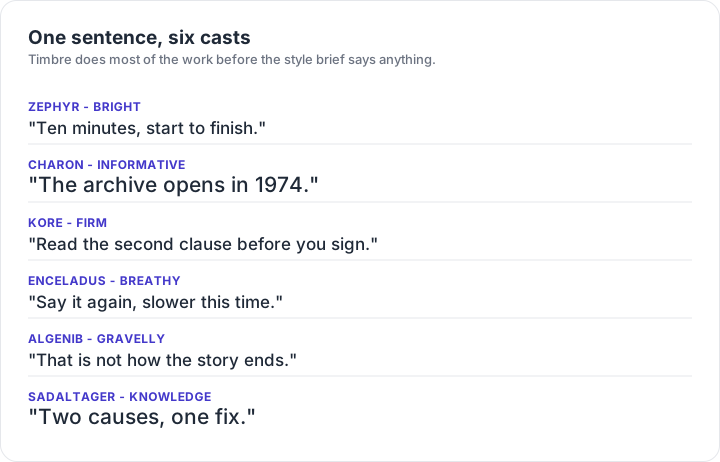
Listen for the difference between timbre and delivery. Zephyr and Puck can both read a friendly line; the difference is the shape of the vowel and the amount of air around the consonants. If swapping voices changes nothing about a line, the problem is the writing: the sentence has no opinion in it, and no voice can supply one.
Pairing two voices
A single request supports two speakers, which is enough for interviews, explainers with a co-host, and dialogue scenes. The rule that saves the most time is contrast: pick two tones that are clearly different so a listener can tell who is talking without looking at the transcript.
- Puck and Charon — friendly host with an informative narrator. The workhorse pairing for explainer videos and course intros.
- Kore and Fenrir — firm, controlled lead with an excitable guest. Good for sports, launches and anything with a hype beat.
- Aoede and Sadaltager — breezy, easy-going travel voice against a knowledgeable lecturer. Works for documentary-style two-handers.
Keep two-speaker scenes short. Over a long scene the second voice tends to drift toward the first, and the repair costs more than generating the two halves separately and editing them together.
Auditioning without wasting renders
- Write one eight-second test line that contains a comma, a number and a proper noun — the three things that break a read.
- Generate that same line across three candidates, not thirty. Three is enough to eliminate.
- Judge on the playback path your audience uses: a laptop speaker exposes sibilance that headphones hide.
- Note the voice name, the tone and the brief in one place. The file name is not enough once a project has ten takes.
Frequently asked questions
How many voices does Gemini TTS include?
Thirty preset voices ship with the current generation, each with a documented tone, from Bright and Upbeat through Smooth, Gravelly and Knowledgeable. A larger extended library is available through the voice listing filters when you need a specific language, region or accent.
Do the voice names mean anything?
They are mostly moon names from the outer planets, which makes them memorable but not descriptive. The tone label next to each name is the useful part: it tells you what the voice is built to sound like before you spend a render auditioning it.
Can I use the same voice in every video for brand consistency?
Yes, and for a series you should. Pick one preset, write the brief down, and reuse both verbatim. The drift people complain about is almost always a changed brief, not a changed voice.
Which two voices pair well together?
Pair contrasting tones rather than similar ones: Puck with Charon, Kore with Fenrir, or Aoede with Sadaltager. Similar tones blur into one another in a two-speaker scene, and listeners lose track of who is talking.
Is a deeper voice automatically better for narration?
No. Depth reads as authority for corporate and documentary work, but it flattens warmth in explainers and tutorials. Match the tone label to the job first, then adjust pace and energy in the style brief.